 info@triniteconsulting.com
 +1 (224) 385 9760
The BPO industry is undergoing a major shift heading into 2026. What was once primarily a cost-saving lever has evolved into a strategic enabler of organizational efficiency, digital transformation, and operational resilience. Advancements in artificial intelligence, automation, cybersecurity, and industry-specific outsourcing models are redefining how BPO companies support client operations and global workforce strategies.
The Trends Transforming the BPO Industry in 2026
For business leaders and operations teams planning their 2026 operating models, these trends are not theoretical. They directly influence outsourcing decisions, partner selection, and long-term cost and performance outcomes.
AI and Automation: Moving Toward Intelligent Operations
Artificial intelligence and automation remain the most significant forces reshaping the BPO industry and accelerating enterprise digital transformation initiatives. AI-driven automation improves accuracy, speed, and compliance in business workflows, especially in finance, logistics, and healthcare. Tasks that previously required large manual teams are increasingly supported by automated systems that handle document processing, data validation, report generation, and evidence-based decision making.
What’s notable is the shift toward human-in-the-loop automation, where AI manages routine tasks while people focus on higher-value activities requiring judgment, empathy, and problem-solving. Rather than reducing the workforce, automation is reallocating talent toward analytical and customer-centric functions.
This trend aligns with a broader shift: organizations now outsource not just for labor savings, but to gain access to automation-enabled processes that improve accuracy, reliability, and operational performance.
Generative AI and Domain-Specific Models
Generative AI, particularly large language models, is expanding into more sophisticated BPO use cases. Providers now deploy AI tools to support:
- Drafting emails, reports, and summaries
- Multilingual communication
- Knowledge search for customer service
- Workflow documentation
- Data classification and insight extraction
A growing movement involves domain-specific AI models, especially in regulated industries such as insurance and healthcare. These models are trained on industry terminology and workflows, leading to better accuracy and reduced compliance risk compared with generic AI systems.
Even with generative AI adoption rising, human oversight remains essential to ensure factual accuracy and alignment with client-defined quality standards.
Knowledge Process Outsourcing: Moving Up the Value Chain
Companies increasingly outsource analytical and knowledge-driven work, giving rise to Knowledge Process Outsourcing (KPO). Unlike traditional BPO, KPO supports functions such as:
- Market and customer analytics
- Financial modeling
- Legal research
- Clinical and medical documentation
- Competitive intelligence
The shift toward KPO reflects a growing need for specialized expertise and insights rather than simple task execution. Many organizations now use hybrid models — keeping sensitive or customer-facing functions onshore while outsourcing analytical or back-office work offshore for efficiency and scalability.
Hybrid Work Models Unlocking Global Talent
Digital collaboration tools have enabled BPO operations to adopt hybrid and remote models at scale. This allows providers to source talent globally, assemble distributed teams, and create multi-shore delivery models tailored to client needs.
Healthcare and financial services, which require stricter compliance, frequently use nearshore delivery to balance security with operational efficiency. Nearshore models also improve time-zone alignment and communication quality.
Mordor Intelligence notes that healthcare BPO in particular is expanding rapidly due to rising administrative workloads, ongoing coding transitions, and shortages of skilled medical billing and documentation specialists.
Omnichannel Customer Experience as a Standard Expectation
Customer experience has moved beyond individual channels. Today, organizations expect BPO providers to deliver unified, consistent, and contextual support across email, chat, voice, messaging applications, and self-service portals.
To meet this expectation, BPO firms invest heavily in:
- Unified customer data systems
- Real-time analytics
- AI-augmented agent tools
- Workflow orchestration platforms
Agents must be equipped to handle interactions that move seamlessly between channels — a skill set that blends communication proficiency with digital fluency.
Talent Development and Retention
Despite automation, talent remains central to BPO success. High attrition has historically challenged the industry, but leading providers are responding with enhanced investments in:
- Upskilling in AI and digital tools
- Leadership training
- Clear career advancement frameworks
- Flexible and hybrid work options
Talent development has become a competitive differentiator. High-skill BPO and KPO functions rely on experienced personnel who can manage complex workflows and deliver strategic value.
Cybersecurity: Protection and Resilience
With BPO providers handling sensitive financial, healthcare, and customer data, cybersecurity is now a board-level priority. Palo Alto Networks’ 2026 predictions emphasize a shift from pure prevention to cyber resilience, which focuses on rapid detection, containment, and recovery.
Key trends reshaping cybersecurity in BPO include:
- Zero-trust security adoption
- AI-driven threat detection and exposure management
- Continuous monitoring of digital workflows
- Protection of AI agents and automated systems
- Increased governance oversight at the board and regulatory levels
Clients increasingly evaluate outsourcing partners based on their security architecture, certifications, and operational resilience.
Healthcare and Finance: Leading BPO Growth
Healthcare and finance continue to be two of the strongest BPO growth sectors. MarketsandMarkets reports that the healthcare BPO market is projected to grow steadily due to administrative burden, coding transitions, and increasing demand for revenue cycle management.
In finance and accounting, AI-driven automation is improving:
- Compliance and audit readiness
- Reporting accuracy
- Turnaround times
- Forecasting and analytics capabilities
As organizations navigate talent shortages and rising operational costs, outsourcing these functions provides both scalability and specialized expertise.
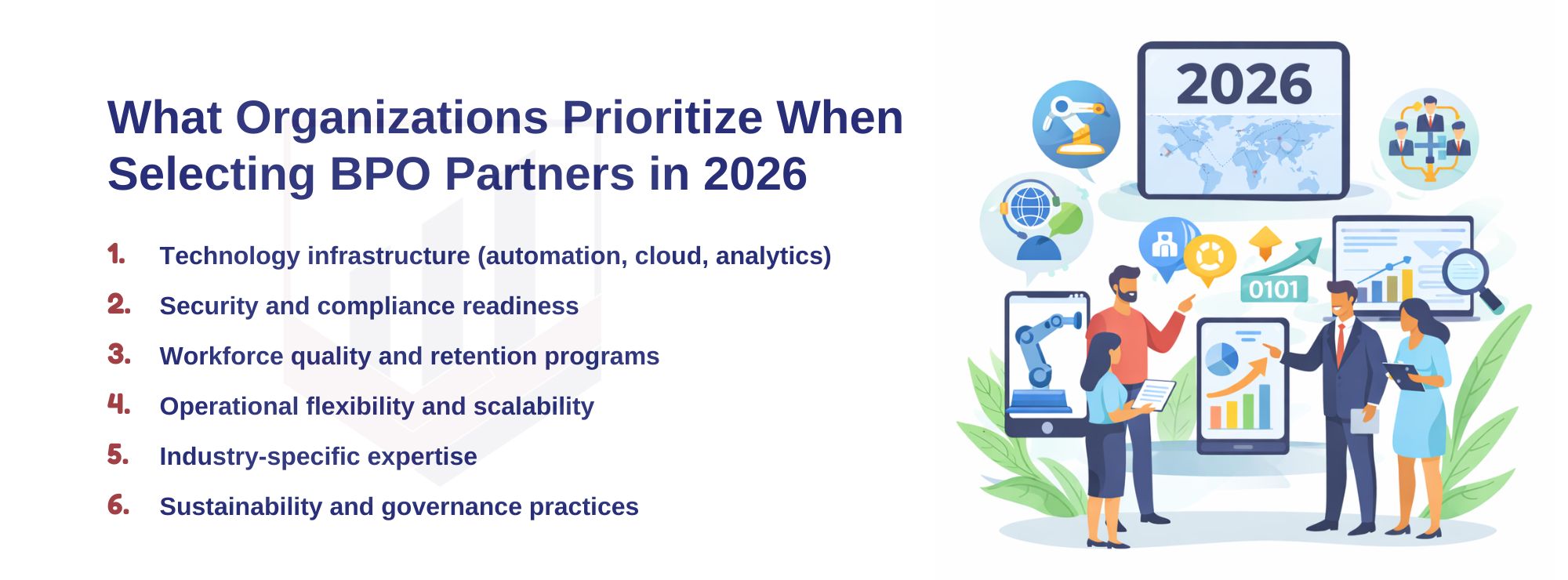
What Organizations Prioritize When Selecting BPO Partners in 2026
As outsourcing decisions become more strategic, choosing the right BPO partner is a business decision that impacts long-term efficiency, risk, and scalability.
Companies looking to outsource in 2026 typically evaluate partners based on:
- Technology infrastructure (automation, cloud, analytics)
- Security and compliance readiness
- Workforce quality and retention programs
- Operational flexibility and scalability
- Industry-specific expertise
- Sustainability and governance practices
Organizations increasingly view BPO as a long-term transformational partnership, not a short-term transactional contract
Conclusion
The BPO landscape of 2026 is defined by intelligent automation, specialized knowledge functions, stronger cybersecurity, and a global, flexible talent model. Companies that embrace these trends — and partner with BPO providers equipped to deliver technology-enabled, resilient, and high-quality operations — will be positioned for long-term efficiency and competitive advantage.
The BPO landscape of 2026 is defined by intelligent automation, specialized knowledge functions, stronger cybersecurity, and a global, flexible talent model. For organizations planning the next phase of their operating strategy, engaging the right BPO service provider can help translate these trends into measurable outcomes improving efficiency, resilience, and long-term performance.
Get Consultation
Related Blogs
Recent Blogs
Partner with us today!


