 info@triniteconsulting.com
 +1 (224) 385 9760
How Business Consulting Drives Sustainable Growth in Financial Services
Sustainable growth in financial services is rarely accidental. It is built on disciplined strategy, operational control, risk awareness, and the ability to scale without losing efficiency. In an industry shaped by regulatory complexity, margin pressure, and digital disruption, growth must be both profitable and repeatable.
This is where a business consultant plays a transformative role, not as an external advisor delivering one-time recommendations, but as a strategic partner embedding structured, measurable improvement into the organization.
Moving Beyond Short-Term Fixes
Many financial institutions pursue growth through product expansion, market entry, or technology upgrades. Yet without operational alignment, these initiatives often strain internal systems.
Effective consulting models focus on:
- Financial operations & performance management
- Treasury and cash management optimization
- Financial reporting, controls, and compliance
- Strategic finance, financial modeling, and scenario analysis
- M&A and transaction support
- Portfolio monitoring and investment analysis
Instead of isolated interventions, consulting frameworks align strategy with execution, ensuring growth initiatives are supported by scalable processes.
Therefore, sustainable growth is defined as controlled expansion and not merely fast expansion.
Embedding a Consulting-Led Operating Model
The most effective consulting engagements work side-by-side with corporate development, strategy, and finance teams, embedding structured decision-making and KPI-driven execution
This approach ensures:
- Data-driven recommendations tied to measurable business KPIs
- Clear reporting of assumptions and logic (no black-box models)
- Repeatable execution frameworks
- Governance structures that strengthen accountability
When strategy translates into documented, scalable workflows, growth becomes less dependent on individuals and more embedded in the system.
Process Excellence as a Growth Multiplier
In financial services, inefficiency directly impacts margins. Turnaround delays, documentation gaps, underwriting backlogs, claims leakage, and reporting bottlenecks all erode profitability.
Consulting-led Continuous Improvement & Optimization (CI&O) frameworks address these structural inefficiencies
The impact can be dramatic:
- Process efficiency improvements of up to 80%
- Turnaround time reductions from 49 days to 8 days
- Delivery cost reductions of up to 60%
- Profitability improvements by multiple percentage points
These are not marginal improvements; they fundamentally alter a firm’s growth trajectory. When operational friction decreases, revenue scales without proportional cost increases.
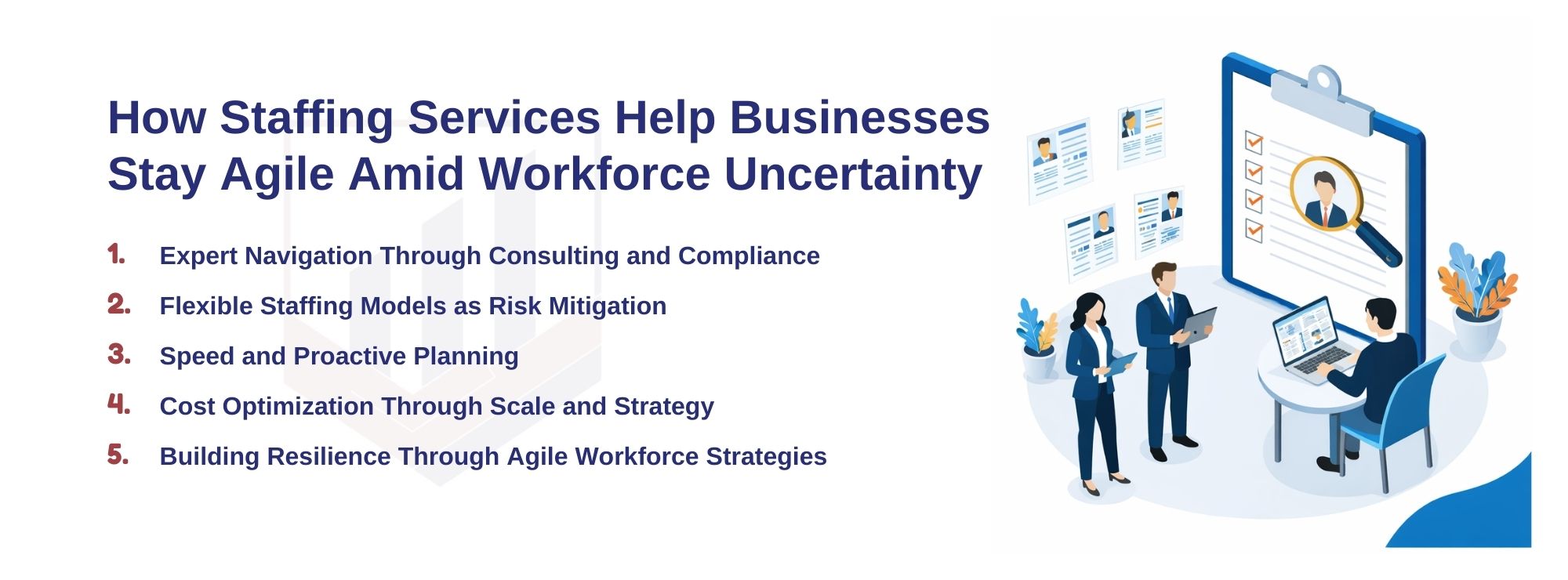
Staffing as a Strategic Growth Lever
Growth often stalls because internal teams are stretched thin. Hiring cycles are slow. Skill gaps widen. Compliance demands increase.
Strategic staffing services, when aligned with consulting frameworks, becomes a powerful lever for growth:
- Rapid deployment of finance, underwriting, actuarial, and risk professionals
- Flexible capacity during peak transaction or policy cycles
- Access to specialized talent without long-term fixed overhead
Rather than simply filling roles, staffing models designed within a consulting strategy ensure that talent placement aligns with operational objectives and performance metrics.
In high-growth phases, staffing flexibility prevents operational breakdown.
In cost-sensitive phases, it protects margins.
BPO as an Efficiency and Scalability Engine
Business Process Outsourcing (BPO) is often misunderstood as a cost-cutting measure. In reality, when structured properly, it becomes a scalability engine.
In financial services, BPO can support:
- End-to-end policy lifecycle management
- Call center and back-office operations
- Claims administration
- Underwriting support
- Finance and accounting operations
The right model enhances visibility, improves accuracy, and accelerates turnaround times, all while maintaining governance controls
For example, comprehensive BPO for insurance companies have enabled seamless policy administration and improved operational efficiency across functions and organizations.
When consulting defines the process architecture first, BPO becomes a performance lever, not just an outsourcing decision.
Linking Strategy, Execution, and Cost Structure
Sustainable growth requires alignment between:
- Strategic ambition
- Operational capacity
- Cost structure
Consulting provides the blueprint.
Staffing provides capacity.
BPO provides scalable execution.
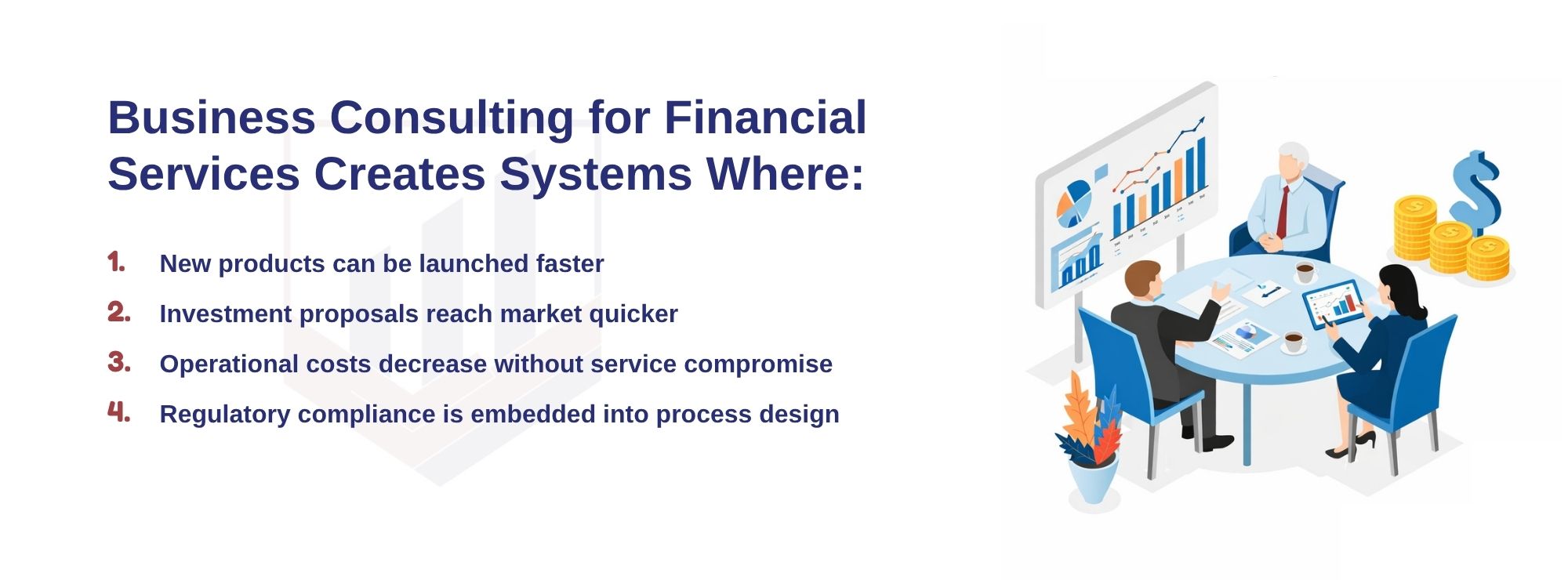
Together, they create a system where:
- New products can be launched faster
- Investment proposals reach market quicker
- Operational costs decrease without service compromise
- Regulatory compliance is embedded into process design
For example, financial and strategic analysis frameworks have reduced lead time to market by 33% while generating significant operational cost savings in finance and accounting functions
This is sustainable growth in practice: faster, leaner, and structurally stronger.
Insurance, Risk & Specialty Lines: A Complex Growth Arena
Insurance and specialty financial segments face unique challenges:
- Actuarial modeling complexity
- Medical professional liability
- Specialty lines (Auto, Inland Marine, Excess of SIR)
- Reinsurance structures
In these areas, growth depends heavily on disciplined underwriting processes, risk assessment models, and documentation controls.
Consulting frameworks ensure that underwriting, claims, and reinsurance functions operate within defined risk parameters while maintaining speed and responsiveness.
Without operational discipline, growth in specialty lines increases exposure.
With structured consulting oversight, growth becomes controlled expansion.
From Cost Center to Profit Driver
The ultimate goal of business consulting in financial services is to reposition operations from a cost center to a profit driver.
When:
- Processes are standardized
- KPIs are embedded
- Talent is aligned strategically
- BPO supports structured scalability
- Reporting is transparent and assumption-driven
Financial institutions can grow without losing control.
Sustainable growth is not about aggressive expansion.
It is about building a system where strategy, people, process, and execution reinforce one another.
The Bottom Line
In financial services, growth without structure increases risk.
Structure without agility limits growth.
Business consulting bridges this gap, creating frameworks where:
- Strategy becomes measurable
- Operations become efficient
- Staffing becomes flexible
- BPO becomes scalable
When these levers are aligned, financial institutions do not just grow, they build resilient, repeatable, and profitable growth models that endure market cycles.
Get Consultation
Related Blogs
Recent Blogs
Partner with us today!


