 info@triniteconsulting.com
 +1 (224) 385 9760
The insurance industry is undergoing rapid transformation. Tight regulatory requirements, rising customer expectations, competitive pricing pressure, and operational complexity are forcing insurers to rethink how they operate. Companies must improve productivity, reduce operating costs, and enhance customer experience — all at the same time.
Business Process Outsourcing (BPO) has emerged as a strategic solution that helps insurance companies navigate these challenges. By outsourcing non-core functions to specialized providers, insurers can streamline operations, improve efficiency, reduce costs, and focus on growth-oriented initiatives.
What is a BPO Partner for Insurance Companies?
A BPO partnership for insurance refers to delegating specific operational functions to third-party service providers. These functions may include claims processing, underwriting support, policy administration, customer service, accounting, data management, and compliance support.
Rather than investing heavily in infrastructure, hiring, and training, insurers gain access to specialized expertise, automation capabilities, and scalable delivery models. This enables them to focus internal resources on core competencies such as risk strategy, product innovation, and customer engagement.
Key Challenges Facing Insurance Companies
Insurance companies today face multiple operational and strategic pressures:
- Constantly evolving regulatory requirements
- Increasing competition and pricing pressure
- High operational and training costs
- Demand for 24/7 customer support
- Complex claims management
- Data security and compliance risks
Balancing cost reduction with service excellence is no longer optional — it is essential for survival.
Core Insurance Processes That Can Be Outsourced and Optimized
1. Claims Processing
Claims management is volume-intensive and highly process-driven, making it ideal for outsourcing. BPO providers can handle:
- Claims intake and verification
- Investigation support
- Liability assessment
- Payment processing
- Regulatory documentation
With automation and AI integration, settlement timelines can be significantly reduced while improving accuracy and customer satisfaction.
2. Policy Administration
Policy servicing involves repetitive administrative tasks that consume internal resources. Outsourcing can support:
- Policy issuance and documentation
- Premium billing and collections
- Endorsements and renewals
- Compliance documentation
Specialized platforms reduce processing errors and improve turnaround time.
3. Underwriting Support
While final underwriting decisions often remain in-house, support functions can be outsourced, including:
- Risk assessment data gathering
- Document verification
- Background checks
- Database integration
BPO partners equipped with analytics tools can enhance risk evaluation efficiency and speed.
4. Customer Service and Call Centers
Customers expect quick, personalized service across multiple channels. Outsourcing enables:
- 24/7 call center operations
- Multichannel support (phone, chat, email)
- Complaint handling and follow-ups
- Claims status updates
This improves responsiveness while freeing internal teams to focus on complex customer interactions.
5. Data Processing and Data Mining
Insurance operations generate large volumes of data. Outsourcing data management helps with:
- Accurate data entry
- Transaction processing
- Customer-level analysis
- Fraud detection support
- Outstanding claims estimation
- Sales and marketing insights
Advanced analytics enable better decision-making, pricing optimization, and risk forecasting.
6. Accounting and Financial Services
Financial accuracy and regulatory reporting are critical in insurance. Outsourced services may include:
- Premium reconciliation
- Agent commission processing
- Financial reporting
- Regulatory compliance documentation
Specialized BPO providers ensure financial transparency and compliance with standards such as IFRS and other regulatory frameworks.
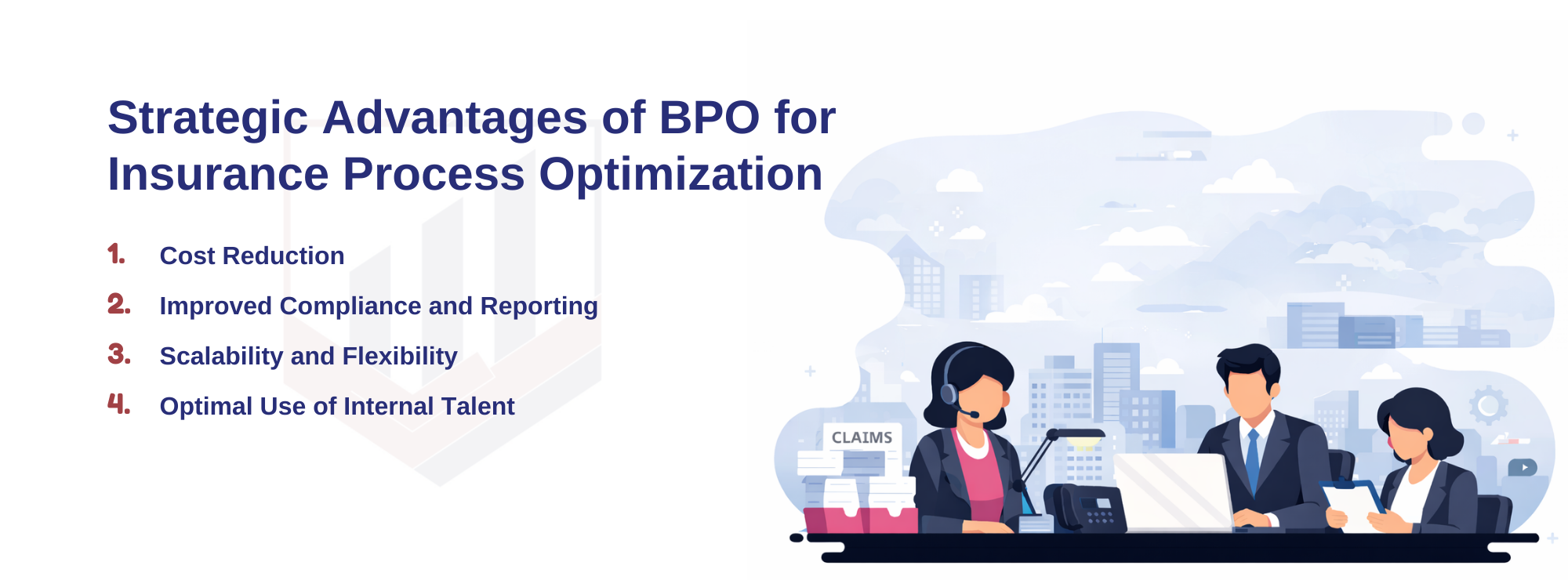
Strategic Advantages of BPO for Insurance Process Optimization
1. Cost Reduction
Outsourcing significantly lowers operating expenditures by reducing:
- Recruitment and training expenses
- Employee benefits and statutory costs
- Infrastructure and office space requirements
- Technology investment
Instead of fixed overhead costs, insurers shift to flexible service-based pricing models.
2. Improved Compliance and Reporting
Insurance regulations frequently change. Outsourcing partners with dedicated compliance teams help:
- Monitor regulatory updates
- Revise documentation
- Maintain audit trails
- Ensure data security
This reduces risk exposure and strengthens governance.
3. Scalability and Flexibility
Unlike full-time employees, outsourcing agreements can be scaled up or down based on business needs. During peak claim seasons or expansion phases, insurers can quickly increase operational capacity without long-term commitments
4. Optimal Use of Internal Talent
Employees are valuable strategic assets. By removing repetitive clerical tasks, insurers allow internal teams to focus on:
- Product innovation
- Strategic risk management
- Market expansion
- Customer relationship development
This shift enhances productivity and organizational growth.
Compliance Best Practices in Insurance BPO
To ensure secure and compliant outsourcing, insurers should prioritize:
- Dedicated legal and compliance teams
- Customized regulatory frameworks
- Regular staff compliance training
- Strong data encryption and access controls
- Clear contractual accountability
- Periodic internal audits
- Use of compliance management tools
- Industry certifications such as ISO 27001 and SOC 2
A structured compliance framework protects both the insurer and the BPO partner. Additionally, insurers can choose to work with a business consulting firm who specialized in Insurance Process Optimization, as they would guarantee the implementation of compliance best practices.
Technologies Empowering Insurance BPO
Technology plays a central role in modern insurance outsourcing.
Robotic Process Automation (RPA)
Automates repetitive tasks such as data entry, policy updates, and claims processing, reducing errors and costs.
Machine Learning (ML)
Enhances fraud detection, predictive analytics, pricing models, and risk forecasting.
Blockchain
Creates secure, tamper-proof records for policy documentation and claims tracking, increasing transparency.
Cloud Computing
Enables centralized data access, seamless collaboration, and scalable infrastructure without heavy capital investment.
These technologies allow insurers to modernize operations while maintaining agility.
Selecting the Right BPO Partner
Outsourcing success depends heavily on partner selection. Key evaluation criteria include:
Insurance Domain Expertise
The provider must have proven experience in insurance-specific processes.
Regulatory Knowledge
A deep understanding of industry regulations such as GDPR, HIPAA, and regional insurance laws is essential.
Technological Capability
The partner should leverage automation, AI, analytics, and secure cloud platforms.
Disaster Recovery and Business Continuity
Strong infrastructure ensures uninterrupted service during disruptions.
Transparent Communication and KPIs
Regular reporting, measurable performance metrics, and clear service-level agreements ensure accountability.
Choosing the right partner ensures both operational efficiency and long-term strategic alignment.
Conclusion
Business Process Outsourcing has evolved from a cost-saving tactic to a strategic growth enabler in the insurance industry. By outsourcing operational functions, insurers can:
- Reduce overhead costs
- Improve compliance and reporting
- Enhance customer experience
- Increase operational efficiency
- Scale quickly with market demand
- Focus on innovation and core strategy
As automation, AI, and analytics continue to reshape insurance operations, BPO will play an even more critical role in driving competitive advantage.
Get Consultation
Related Blogs
Recent Blogs
Partner with us today!


